
What AI Autonomous Coding Actually Means for Your Career
AI autonomous coding is here — and it's already running at 95–98% accuracy in live health systems. Here's what it actually means for medical coders, HIM professionals, and Revenue Cycle specialists, and exactly what to do next.

AI autonomous coding is here — and it's already running at 95–98% accuracy in live health systems. Here's what it actually means for medical coders, HIM professionals, and Revenue Cycle specialists, and exactly what to do next.
I'm Going to Be Honest With You About What's Actually Happening
I've been in Health Information Management for 19+ years. I've watched this industry transform more times than most people have changed jobs. And when something significant is happening in the market, I don't soften it — I tell you exactly what I'm seeing and what it means for your career.
So here's what I'm seeing right now.
In February 2026, HFMA published a case study featuring a Midwestern health system that implemented Solventum's 360 Encompass™ Autonomous Coding system across four facilities simultaneously. This wasn't a pilot program in a controlled environment. This was live production coding in a real health system, on real patient encounters, affecting real revenue.
The results documented in HFMA's coverage of the case study were significant enough that I think every coder, every HIM professional, and every revenue cycle specialist needs to understand what happened — and what it means for you specifically.

What the Case Study Actually Found — The Numbers You Need to Know
Let me walk you through the data, because I think when people hear "AI coding," they picture either a minor efficiency tool or a full replacement. The reality is more nuanced than either of those takes — and actually more useful for your career planning.
According to the HFMA case study, the Midwestern health system implemented Solventum's 360 Encompass™ Autonomous Coding system inside their Meditech Expanse EHR across four facilities. Here is what the implementation produced:
Up to 80% of Coding Volume Was Automated
The health system achieved up to 80% coding automation across eligible ancillary encounter types. As HFMA reported, this represents a substantial portion of the routine, lower-complexity volume that has historically occupied a large share of coder time — and it happened at production scale, not in a test environment.
Coders Were Upskilled — Not Eliminated
This is the part that is being lost in the broader AI-in-healthcare conversation. The headline of the HFMA article itself tells you what actually happened: the health system unlocked 80% coding automation and upskilled teams for complex cases. Those two things happened together. The coding team didn't shrink and disappear — it shifted. Coders moved into higher-complexity work: the cases, exceptions, and clinical scenarios that autonomous systems are not equipped to handle independently.
Accuracy Reached 95–98% by Account Category
Solventum's 360 Encompass™ system reached 95–98% coding accuracy by account category in production. That is not experimental accuracy. For comparison, human coder accuracy benchmarks typically range from 95–97% — meaning this system is operating within the same accuracy band as experienced coders on the encounter types it processes autonomously.
Epic EHR Expansion Already Planned for 2026
The implementation in Meditech Expanse is not considered a finished rollout. The health system has already planned to extend autonomous coding into their Epic EHR environment in 2026. This signals something important about the trajectory: organizations that implement autonomous coding are not pulling back after the pilot. They are expanding.
People keep asking me: "Valerie, should I be scared?" And my answer is the same every time: scared is not a strategy.
Yes, this case study confirms that AI is now capable of handling up to 80% of routine coding volume at production-grade accuracy. That is a real shift. I'm not here to minimize it.
But the HFMA headline says it plainly: upskills teams for complex cases. That is the actual outcome of this implementation. The professionals who understand what this shift means are the ones who will use it to their advantage. The window for strategic repositioning is open right now — not eventually.
Here's What the Headlines Are Getting Wrong
When AI coding stories circulate, the framing is usually one of two things: either "AI will replace coders" or "AI is just an efficiency tool." Both framings miss what the data actually shows.
The coders in the Solventum case study were not replaced. They were repositioned into higher-complexity, higher-judgment work.
When up to 80% of routine ancillary volume is handled by an autonomous system, that doesn't mean the coding team disappears. It means the work fundamentally changes. The remaining volume — the complex cases, the exceptions, the records that don't meet autonomous coding criteria — still requires experienced human review. And that work is significantly higher-judgment and increasingly higher-paid than routine ancillary coding volume.
Beyond that: someone has to oversee the autonomous system. Someone has to audit its accuracy. Someone has to catch the patterns in what the system gets wrong, escalate compliance concerns, and maintain revenue integrity. Someone has to ensure the documentation feeding the system is clean enough to produce accurate outputs in the first place. That work doesn't go away when you implement AI. It expands.
And that expansion has a job title. It's called Revenue Integrity.
Revenue Integrity professionals oversee autonomous systems, audit outputs, manage exceptions, catch compliance exposures, and protect revenue that AI cannot evaluate without human domain knowledge. According to Solventum, 360 Encompass™ is specifically designed to free coders from routine volume so they can focus on the complex, high-value work that requires clinical knowledge and professional judgment. This is not a shrinking function. It is one of the fastest-growing categories of non-clinical healthcare work right now.
We've Done This Before. And We Came Out Ahead.
I want you to think back to something. Because I've been in this industry long enough to remember it clearly.
Remember the transition from paper records to EHRs?
If you were in HIM during that era, you know exactly what that felt like. The uncertainty. The "what is going to happen to my job?" conversations in break rooms. The sense that the ground was shifting and nobody could tell you where it was going to settle.
That transition was massive. Some roles were eliminated. Certain manual, paper-based positions became obsolete almost overnight.
But here's what also happened: the EHR transition created entirely new categories of jobs that didn't exist before. EHR implementation specialists. Clinical informatics analysts. Health IT trainers. EHR optimization consultants. Workflow analysts. System administrators with healthcare domain expertise. These positions were built from scratch to support the digital environment — and the professionals who leaned into that change leveled up significantly. Many of them are now in some of the highest-paying, most stable non-clinical roles in the industry.
The AI shift is the same pattern — just faster and at larger scale. Routine volume gets automated. New, higher-judgment roles get created. The professionals with deep domain knowledge in how healthcare data actually works — clinical documentation, coding, billing, compliance, EHR workflows — become the people those systems cannot function without.
The question has never been "will healthcare change?" It always changes. The question is: will you be one of the people who helps shape what it changes into?

What "Repositioning" Actually Looks Like
I don't want to leave you with a principle without showing you what it looks like in practice.
As autonomous coding scales across health systems, the repositioning happening in the market is showing up in specific ways. The Solventum 360 Encompass™ system is specifically designed so that coders shift focus from routine ancillary encounters toward the complex cases, exception management, and quality oversight that require professional judgment. Here is how that translates into real career paths:
Revenue Integrity Analyst
This is the direct career output of the autonomous coding shift. Revenue Integrity Analysts oversee charge accuracy, audit coding outputs — including AI-generated outputs — identify compliance exposures, and work across clinical and financial teams to close revenue gaps. If you have a CPC, CCS, RHIT, or RHIA, your credential is listed as a requirement in most of these postings. This is your lane.
Charge Capture Auditor
Someone has to validate what the autonomous system produces. Charge Capture Auditors focus on ensuring that charges are complete, accurate, and billable — the work that requires clinical and coding knowledge the AI cannot apply independently. Coding certification plus auditing experience is the typical entry point. This role is expanding in direct proportion to autonomous coding adoption.
Clinical Data Quality Specialist
Autonomous coding systems are only as good as the documentation they code from. Clinical Data Quality Specialists work at the front end of that process — ensuring documentation integrity is high enough for accurate autonomous output. This role draws on CDI, HIM, and compliance backgrounds and is increasingly appearing at health systems that have implemented or are planning autonomous coding rollouts.
CDM Analyst (Charge Description Master)
As autonomous systems scale, charge master accuracy becomes even more critical — because the AI codes to what the CDM says. Experienced coders who understand ICD, CPT/HCPCS, and hospital charge workflows are uniquely positioned for this role. It is one of the most underdiscussed pivot opportunities in this space right now.
Where Your Background Already Fits
No matter where you're starting from in healthcare — your background has a place in this repositioning.
- → Medical Coders — Revenue Integrity auditing, CDM analysis, charge capture oversight, complex exception review
- → HIM Professionals — Clinical data quality, documentation integrity, compliance oversight of autonomous coding outputs
- → Medical Billers — Denial management on AI-generated claims, appeals, AR exception work
- → CDI Specialists — Documentation quality feed into autonomous systems, query management, AI accuracy optimization
- → Health IT / EHR Analysts — Autonomous coding system implementation, Epic build for RC workflows, charge capture optimization
Real People Who Already Made This Move
I'm not asking you to trust a theory. I want you to see what this looks like when someone executes the pivot with the right strategy.
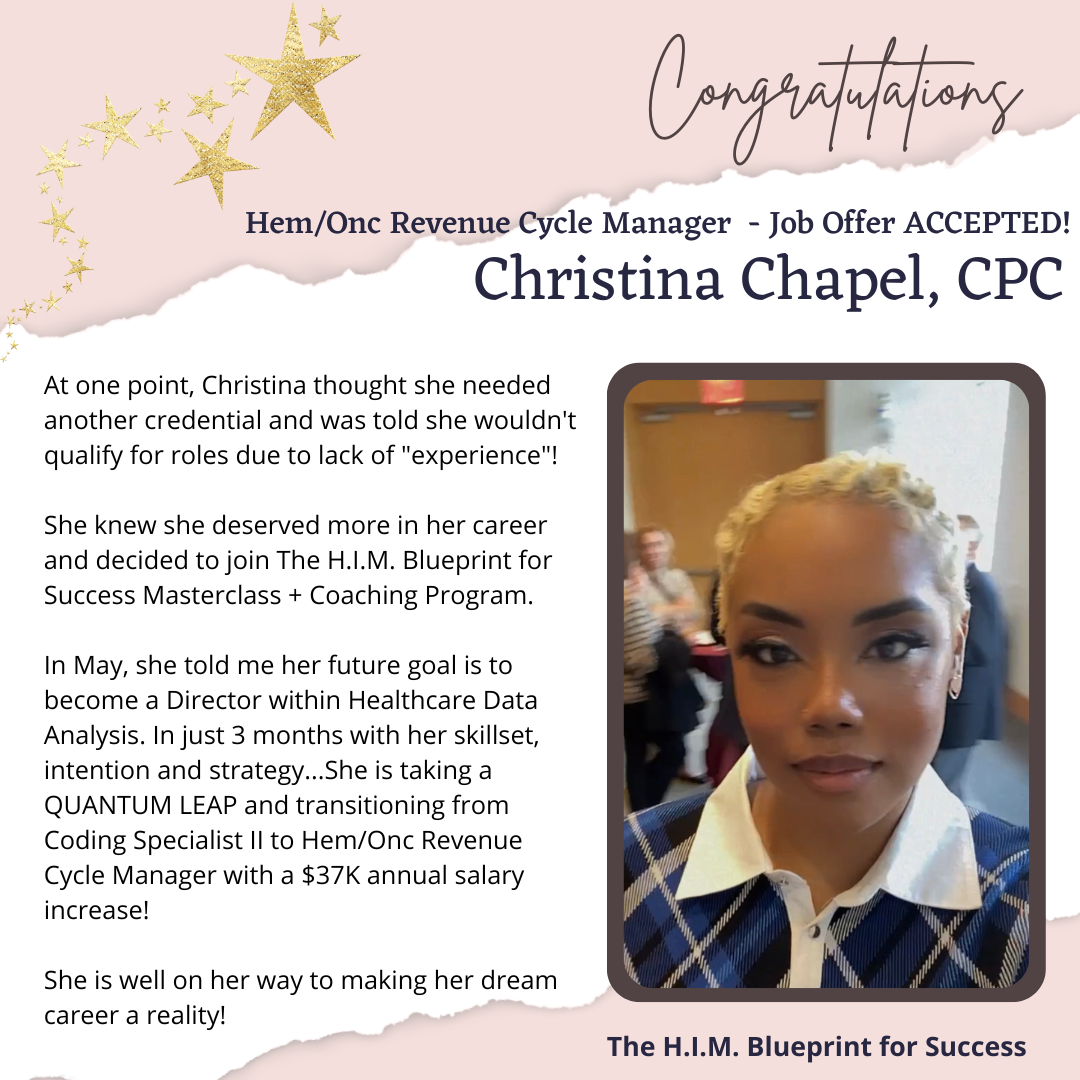
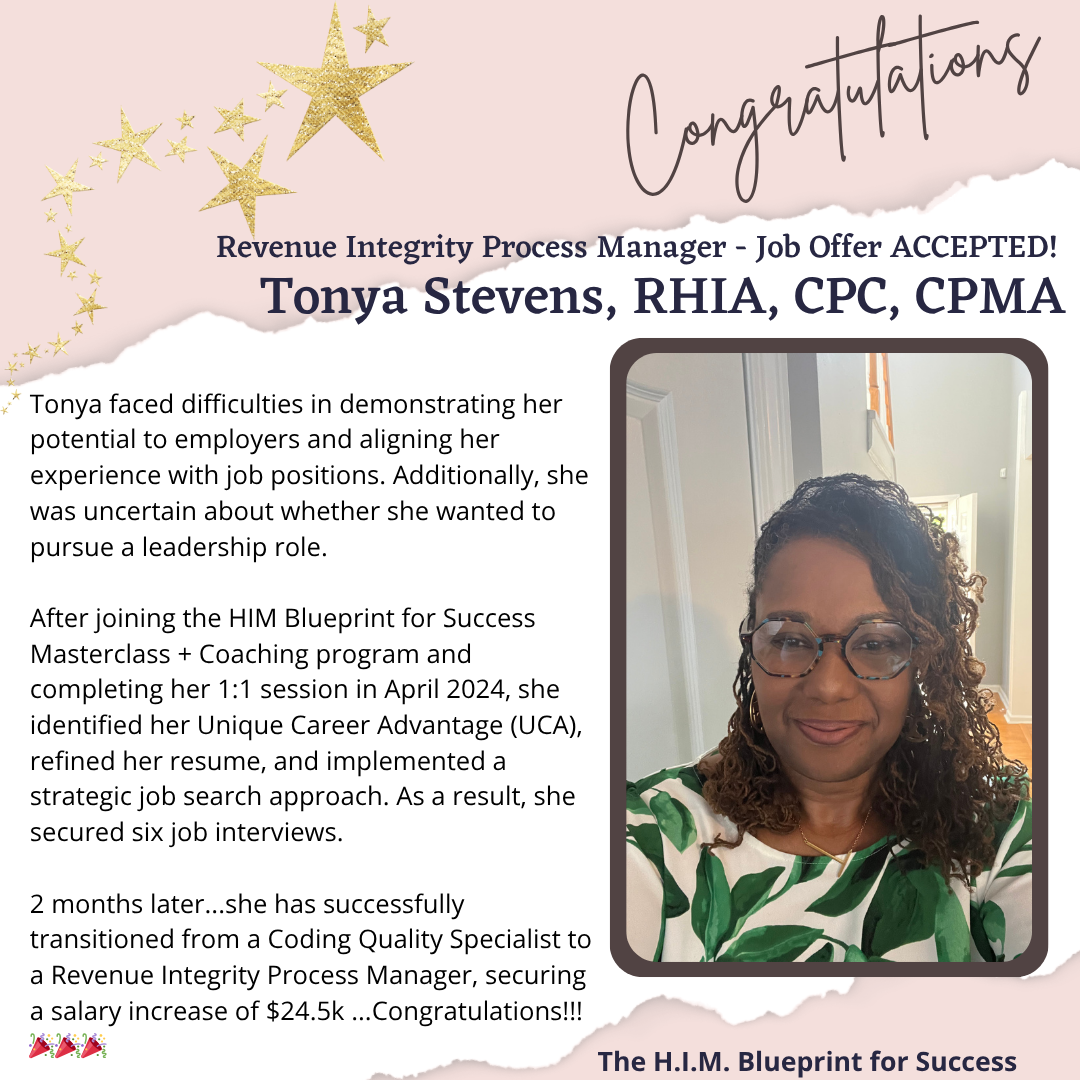
Christina Chapel came from a medical coding background. She made the move into Revenue Cycle management — a $37K salary increase. Tonya Stevens, RHIA, CPC, CPMA, went from Coding Quality Specialist to Revenue Integrity Process Manager — a $24.5K increase. Both did it in months, not years. Not because they had more credentials. Because they repositioned what they already had.
Three Things You Can Do Right Now
1. Stop Waiting to See How This Plays Out
The HFMA case study is not a prediction. It is documentation of a live production rollout that is already expanding into Epic EHR in 2026. Health systems that implement autonomous coding are not reversing course — they are scaling. "Wait and see" is not a neutral position. It is a choice to fall behind while others move forward.
2. Reposition Your Experience in Your Résumé
If you have been in medical coding, CDI, HIM, billing, or compliance, you have the foundational knowledge that Revenue Integrity roles require. But if your résumé still leads with task-based job descriptions instead of audit outcomes, cross-functional work, and revenue impact — you are invisible to the roles that are growing fastest right now. The gap is usually not your experience. It's your positioning.
3. Target the Roles Being Created, Not the Roles Being Automated
Use Blossom to filter specifically for Revenue Integrity, Charge Capture Auditor, CDM Analyst, and Clinical Data Quality roles. These are the functions that expand as autonomous coding handles routine volume. They require the human judgment, regulatory knowledge, and clinical-coding expertise you've been building. The market is paying for it. You just have to show up positioned for it.
The Bottom Line
A Midwestern health system just automated up to 80% of its coding volume using Solventum's 360 Encompass™ system — and HFMA documented it. The accuracy is 95–98%. Epic EHR expansion is already planned. This is not a future scenario. It is a present reality.
And the headline of that HFMA article tells you everything you need to know about the career opportunity inside it: upskills teams for complex cases.
I've spent 19+ years in this industry. I built Blossom specifically for the professionals in this space. I'm not telling you this to create fear. I'm telling you this because the professionals who understand what this shift actually means — who see the repositioning opportunity, not just the disruption headline — are the ones who are going to thrive in the next decade of non clinical healthcare careers.
The shift is not coming. It is here.
Let's get you positioned for it. 🌸
Revenue Cycle & Revenue Integrity Roles on Blossom Right Now
The Market Is Moving.
Your Résumé Should Be Too.
Every role on Blossom is vetted, remote, and ready. No gatekeeping. And if your résumé isn't ready to compete, fix that before you apply.
Browse Revenue Cycle Roles on Blossom →Not sure your résumé is ready? Run it through the Blossom Resume Scorer first.
Sources
- HFMA. Midwestern Health System Unlocks 80% Coding Automation and Upskills Teams for Complex Cases. February 26, 2026. hfma.org →
- Solventum. 360 Encompass™ Autonomous Coding System — AI-Powered Medical Coding for Revenue Cycle Efficiency. solventum.com →