
Oracle, Stargate, and the Healthcare AI Boom: What Non-Clinical Professionals Need to Know Right Now
I told my career strategy members over a year ago to prepare for major shifts in healthcare. Here's the latest update on Oracle's Stargate AI buildout—and what it means for HIM, Health IT, and Revenue Cycle professionals.

I told my career strategy members over a year ago to prepare for major shifts in healthcare. Here's the latest update on Oracle's Stargate AI buildout—and what it means for HIM, Health IT, and Revenue Cycle professionals.
I Said It Over a Year Ago — and Now Here We Are
In February 2025, I posted a warning to the members of my career strategy program. At the time, a lot of people were still in "wait and see" mode when it came to AI and healthcare. I wasn't.
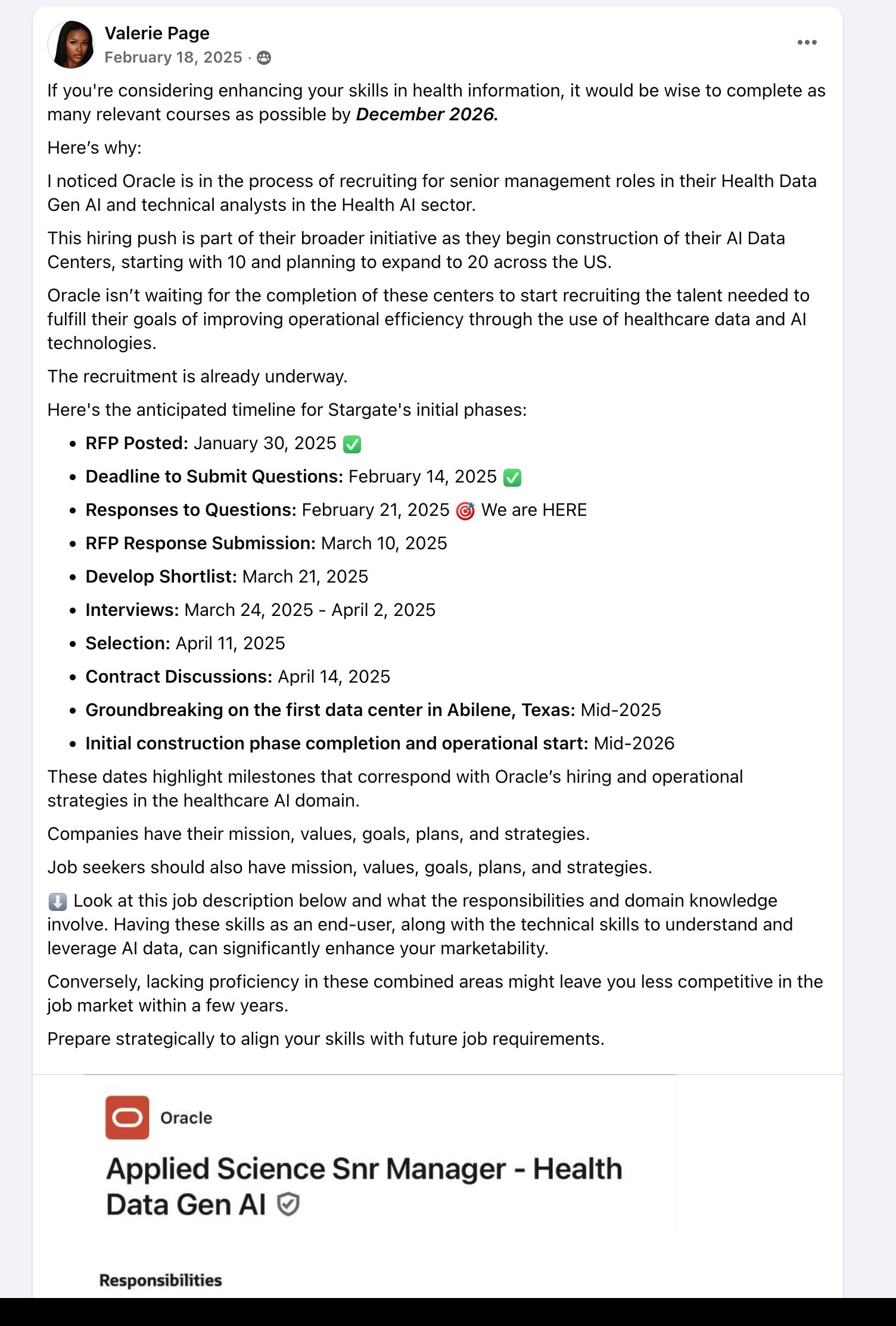
I had been watching Oracle closely. Their recruiting activity in Health Data Gen AI and technical healthcare analyst roles wasn't random—it was strategic. It was tied directly to the launch of what would become one of the largest AI infrastructure projects in American history: Stargate.
I told my community: complete as many relevant courses as possible by December 2026. Get your skills aligned now. The window is closing faster than most people think.
Here's the update. Because what I flagged in 2025? It has not just happened—it has accelerated.

What Is Stargate—and Why Does It Matter for Healthcare?
Stargate is a joint venture between OpenAI, Oracle, and SoftBank. It was formally announced in January 2025 at the White House with a $500 billion commitment to build AI data center infrastructure across the United States.
Oracle's role is specifically focused on building and operating the data centers—and a significant portion of the AI workloads these centers will support are healthcare-related. Health Data Gen AI, clinical documentation intelligence, revenue cycle automation, and health analytics are all part of this picture.
This isn't a research project. This is infrastructure. And infrastructure requires people who understand how healthcare data actually works.
What Has Happened Since February 2025
Here's what the Stargate timeline looks like today compared to where it was when I first posted:
The Abilene, TX Campus Is Already Live
The flagship Stargate site in Abilene, Texas—the one I referenced in my original post—is fully operational. Oracle began delivering NVIDIA GB200 racks in June 2025. Early AI training and inference workloads are already running. This isn't groundbreaking anymore. This is production.
Six States, $450+ Billion, and Counting
Since the original announcement, Stargate has expanded to sites in Shackelford County (TX), Doña Ana County (NM), Lordstown (OH), Milam County (TX), Mount Pleasant (WI), and Michigan—with more under evaluation. Total planned capacity now exceeds 8 gigawatts, with over $450 billion in committed investment over the next three years.
25,000+ Jobs Expected On-Site Alone
The new data centers are projected to create more than 25,000 on-site jobs and tens of thousands more across supporting industries—including healthcare AI, data governance, and technical operations.
OpenAI Academies Are Being Built Into Every Campus
This is the part most people aren't talking about. At each Stargate site, OpenAI is establishing workforce development academies designed to create direct pipelines into high-quality jobs aligned with local AI employers. Credentials. Pathways. Built right into the infrastructure.
Oracle Is Still Actively Hiring for Health AI Roles
Oracle's Applied Science Senior Manager – Health Data Gen AI role (the one I shared in my original post) reflects a broader hiring push that is still very much underway. While Oracle has trimmed some traditional business roles as it redirects resources toward AI infrastructure, the demand for health data, compliance, and analytics talent has not slowed down. It's shifted.
What This Actually Means for HIM, Health IT, and Revenue Cycle Professionals
Let me be direct, because this is why I track this stuff so closely.
The companies building these systems need people who understand healthcare data at its core—not just AI engineers. They need professionals who know:
- How clinical documentation is structured and why it matters
- How revenue cycle workflows connect to data quality
- How to identify and correct data integrity issues in EHR systems
- How to navigate HIPAA, compliance, and health data governance
- How to translate between clinical operations and technical teams
That is a HIM professional. That is a Revenue Cycle analyst. That is a Health IT specialist.
The job titles for these roles don't always say "HIM" or "coder." They say things like:
- Health Data Analyst
- Revenue Integrity Analyst
- AI Model Validator – Healthcare
- Clinical Data Quality Specialist
- Healthcare Compliance Analyst
- Health Information Systems Analyst
If you've been in HIM or revenue cycle for even a few years, you already have the foundational knowledge these roles require. The gap is usually in how you're positioning yourself—not your actual capability.
Let's Be Clear: There Is No Need to Be Afraid
I want to address something directly, because I know this kind of news can feel overwhelming if you're not sure where you stand.
You do not need to be afraid of AI in healthcare. The only professionals who should genuinely be concerned are the ones who refuse to adapt to the changes happening in the industry—and even then, it's a choice, not a fate.
Here's what I want you to think about: we already did this.
Remember the transition from paper records to EHRs? If you were in HIM during that era, you know exactly what that felt like. The uncertainty. The "what is going to happen to my job?" conversations in break rooms and on HIM listservs. The complete overhaul of how we documented, stored, accessed, and coded patient information.
That transition was massive. And yes—some roles were eliminated. Certain manual, paper-based positions became obsolete almost overnight.
But here's what also happened: the EHR transition created entirely new categories of jobs that didn't exist before. EHR implementation specialists. Clinical informatics analysts. Health IT trainers. EHR optimization consultants. Workflow analysts. System administrators with healthcare domain expertise.
The professionals who leaned into the change? They leveled up. Many of them are now in some of the highest-paying non-clinical roles in the industry.
The AI shift is the same pattern—just faster and larger in scale. It will eliminate some tasks. It will automate some workflows. And it will absolutely create new roles that require exactly the kind of domain knowledge you've been building for years.
The question has never been "will healthcare change?" It always changes. The question is always: will you be one of the people who helps shape what it changes into?

The December 2026 Deadline Is Still Very Much in Play
When I said to complete as many relevant courses as possible by December 2026, I wasn't throwing out a random date. That deadline aligns with Phase 1 of Stargate's operational rollout—the point at which multiple data centers are expected to be fully functional and actively scaling their teams.
We are now inside that window. There are roughly eight months left.
The professionals who started preparing in 2025 are now ahead. If you haven't started yet, you're not too late—but "eventually" is no longer a strategy.

Three Things You Can Do Right Now
1. Audit Your Skill Stack Against AI-Adjacent Healthcare Roles
Pull up three to five job descriptions for roles like Health Data Analyst, Revenue Integrity Analyst, or Clinical Data Quality Specialist. Compare the required skills against what you already have. The gaps are usually smaller than you expect—and often fillable through targeted coursework, not a full degree program.
2. Start Talking Like the Job Descriptions Talk
If your resume still leads with "10 years of medical coding experience" and nothing else, you're leaving connections on the table. Phrases like data validation, workflow analysis, cross-functional collaboration, EHR system optimization, and revenue integrity are the language of the roles being created. Use them—because you've probably been doing that work all along.
3. Use Blossom to Find and Track These Roles
Blossom organizes remote healthcare roles by experience level, certification requirements, and skill alignment—including roles in Health IT and analytics that most job boards bury or miss entirely. You can keyword-match your resume, filter for roles that match your current credentials, and track your applications in one place.
Log into your Blossom dashboard and start filtering for analyst and Health IT roles today. The jobs are there. The question is whether you're positioned to be found.
The Bottom Line
A year ago, this was a prediction. Today, it's a construction project that's already in production. The Abilene campus is live. The hiring pipeline is open. The roles being created are ones that people with your background are uniquely qualified for.
I'm not saying this to create urgency for urgency's sake. I'm saying it because I've been in this industry for 19+ years, I built Blossom specifically to help non-clinical healthcare professionals navigate exactly this kind of shift—and I want you to be on the right side of it.
The shift is not coming. It is here. Let's get you positioned. 🌸