

Charge Capture Analyst to Revenue Integrity Auditor in 3 Months — No CPC, $41,500 Raise

Moniek had 17 years in revenue cycle. Charge capture. Billing. Accounts receivable. She knew where the money leaks — where denials originate, where workflow breaks down, where revenue walks out the door before anyone catches it. That is not entry-level knowledge. That is the kind of deep, specific, hard-earned expertise that revenue integrity departments would pay serious money to have on their team.
But she did not have her CPC certification yet. And she had been telling herself — the way so many people do after years in the same lane — that the certification was the wall she had to clear before she could make the move. So she stayed. And she kept being paid like it was year five of a seventeen-year career.
 Career Win Snapshot
| Years in Healthcare | 17 Years |
| Certification | Not certified at time of offer — CPC exam scheduled |
| Previous Role | Charge Capture Analyst |
| New Role | Revenue Integrity Auditor |
| Hiring Company | Optum — Illinois |
| Salary Increase | +$41,500 |
When Moniek was ready to take the next step, she grabbed a resume review using the RACA resume method that is built into Blossom's resume scoring system, identified her Unique Career Advantage, refined her resume, and built a strategic job search approach around what she already had — using the same strategies taught inside Blossom's Elite tier. Three months later, she had gone from Charge Capture Analyst to Revenue Integrity Auditor at Optum — with a $41,500 salary increase — and she secured that role before she was even CPC certified. The CPC exam is scheduled for next month.
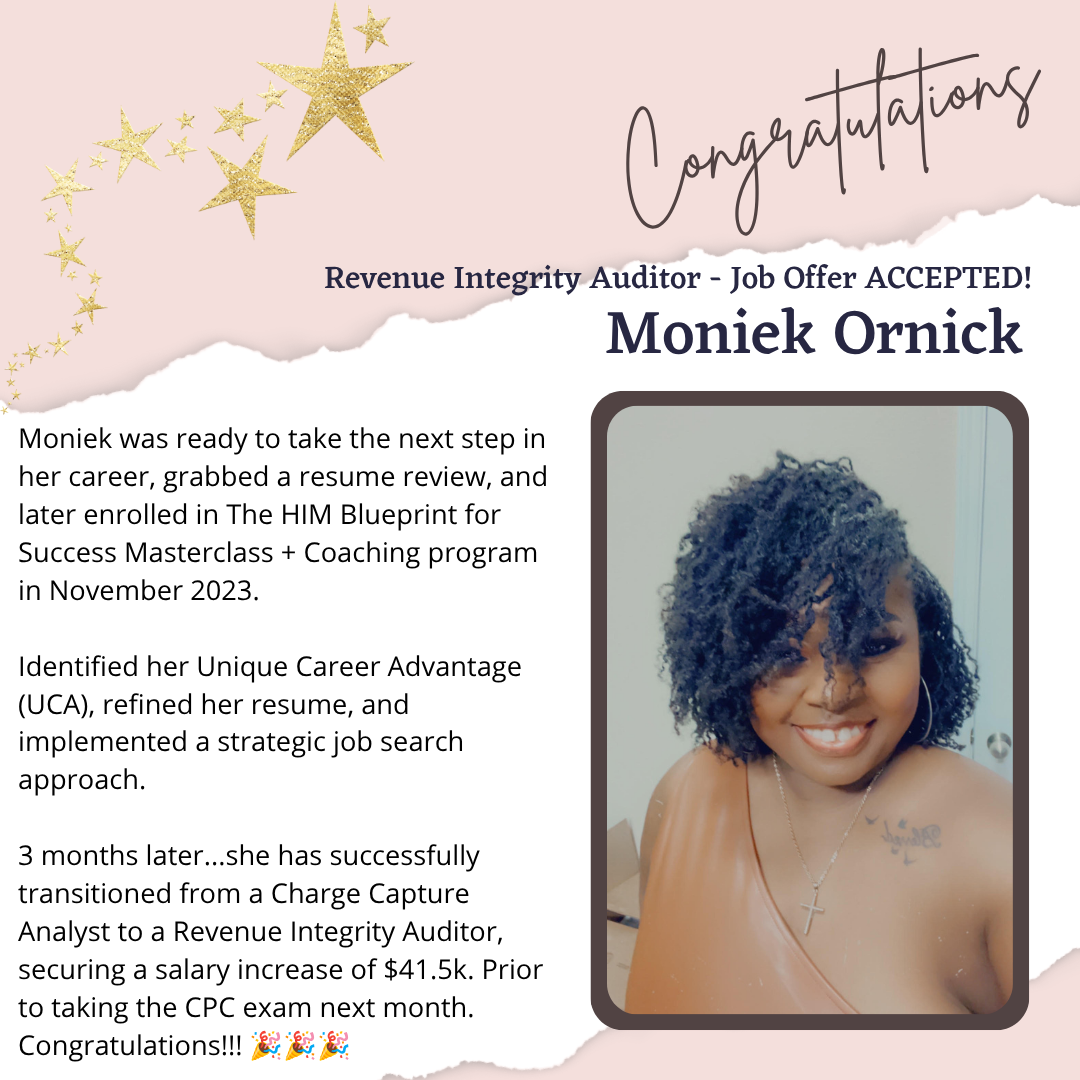
Here is exactly what changed. Because what was standing in her way is probably standing in yours right now too.
Quick Answer: You do not need the CPC certification to transition from a revenue cycle role into revenue integrity — but you do need a resume that accurately surfaces your transferable skills in the language those job postings use, and a job search strategy built around your specific career advantage. According to Valerie Page, RHIT, Founder of Blossom Careers, Moniek went from Charge Capture Analyst to Revenue Integrity Auditor at Optum in 3 months with a $41,500 salary increase — with no certification in hand at the time of her offer. You can score your own resume against positions you want right now at blossom-careers.com/resume.
Most People Apply Blind — And That Is Why They Stay Stuck
Here is what the job search looks like for most revenue cycle professionals who are ready to move up: they find a posting, they send the same resume they have been using, and they wait. No idea what their resume score is against that specific role. No idea which keywords are missing. No idea whether the applicant tracking system filtered them out before a human ever read their name.
They apply blind. And then they wonder why they are not getting callbacks — and they start blaming the certification they don't have yet, or the degree, or the years of experience, when none of those things were actually the problem.
When we scored Moniek's resume against the revenue integrity roles she was targeting, it came back at 33%. On a scale of 0 to 100, a 33% match means two-thirds of the language that job description was looking for was not anywhere in her resume. The ATS was not giving her a chance — and she had no idea, because she had never scored it.
That is the moment everything changes. Not when you get the certification. Not when you hit a certain number of years of experience. The moment you stop applying blind and start applying knowing exactly where you stand.
Score your resume against the roles you want before you submit. Find the gaps. Fix the ones you can honestly fill. Apply with full information. That shift alone changes the entire job search — and it is the first thing Moniek did when she was ready to move.
The CPC Is Not the Wall. Your Resume Might Be.
We want to be direct about something that does not get said enough. The CPC from AAPC is a valuable credential in revenue integrity — worth pursuing, respected by employers, and something that will strengthen your candidacy over time. We are not telling you not to get it. Moniek is sitting for hers next month.
But for someone with 17 years of revenue cycle experience, the CPC is almost never the actual barrier. The actual barrier is a resume that never communicated the depth of what that person already knows.
Moniek was already doing revenue integrity adjacent work every single day. She understood how charges get generated and where they go wrong. She knew how errors in charge capture create downstream compliance exposure. She understood medical necessity, payer logic, and what a denial pattern actually signals about a coding or billing problem upstream. That is not a stretch to revenue integrity. That is a direct bridge.
But her resume was listing tasks — not building that bridge. And tasks don't get you hired into a higher-level role. Results do. Expertise does. A document that makes the hiring manager feel, while reading it, that you are the person they need in that seat.
Once her resume started doing that work, the CPC stopped being the story. Her 17 years became the story — told the right way, in the right language, with the right evidence behind every claim.
What the Unique Career Advantage Changes About Your Job Search
One of the first things we work through with clients at Blossom is identifying their Unique Career Advantage — their UCA. It is the strategy that sits at the core of everything inside our Elite tier, and it is the piece most resume rewrites completely miss.
A UCA is not a list of your skills. It is not a summary of your job history. It is the specific combination of experience, knowledge, and perspective that you bring that someone else — even someone with the same title and years of experience — does not. It is what makes you the right hire for this role, at this employer, right now.
For Moniek, her UCA lived at the intersection of charge capture precision, revenue cycle workflow knowledge, and the ability to trace a denial or compliance issue all the way back to its origin point in the charge entry process. That is exactly what revenue integrity auditors are hired to do. She had been doing it for years — just without the title or the salary that should have come with it.
When you know your UCA, your professional summary stops being a paragraph about your background and starts being a case for why you are the hire. Your career highlights stop being generic wins and start being evidence of the specific expertise this employer needs. Your job search stops being a numbers game — applying everywhere and hoping — and starts being a targeted strategy aimed at the roles where your advantage is the biggest differentiator.
That is what took Moniek from a 33% resume score and zero callbacks to a Revenue Integrity Auditor offer at Optum in 90 days.
Transferable Skills Are a Haymaker — But Your Resume Has to Throw the Punch
Here is what we want every revenue cycle professional reading this to understand. Your transferable skills are powerful. Years in charge capture, billing, denial management, AR — that background maps directly onto what revenue integrity teams need. But transferable skills are only a haymaker if your resume actually throws the punch.
What does that mean in practice? It means your bullet points cannot just describe what you did. They have to describe what happened because of what you did — and they have to use the language that the revenue integrity job description uses, not the language of the revenue cycle job you're coming from.
When we reviewed Moniek's resume, one of the missing keywords was "workflow analysis." She had absolutely performed workflow analysis as a charge capture analyst — she had analyzed charge and AR collection procedures, identified inefficiencies, and built strategies to fix them. But she wasn't calling it that. Her resume was describing the task in revenue cycle language, and the revenue integrity job posting was looking for it in health IT and auditing language.
The fix was not fabricating experience she didn't have. The fix was rewriting what she had already done in the language the employer was actually searching for — and adding quantifiable outcomes to show the business impact. That single change, replicated across her work history, is what closed the gap between 33% and competitive.
Every sentence in your work history should answer this question: what changed, improved, recovered, or got fixed because of what you did? If you cannot answer that for a bullet point, that bullet point needs to be rewritten before you submit that resume anywhere.
The Resume Structure That Revenue Integrity Hiring Managers Actually Read
A resume that is built to open doors into revenue integrity — especially for a candidate making the move from a revenue cycle role — needs four things working together. If any one of these is missing, the whole thing underperforms.
- A professional summary that makes the pivot explicit. Do not make the hiring manager guess how your background connects to revenue integrity. Tell them directly. Name your years of experience, name the relevant expertise, and connect it clearly to what a revenue integrity auditor does. Moniek's rewritten summary made that bridge undeniable — it was not a general career overview, it was a case for the hire.
- Career highlights that prove the depth of your expertise. Two to four quantified wins near the top of your resume — revenue recovered, denial rate reduced, compliance issue caught, process rebuilt. These are evidence. For a candidate moving into auditing without the CPC in hand, a strong career highlights section is what tells the hiring manager that the credential is coming — not that it is missing.
- Skills categorized for readability — professional and personal, separated. Revenue cycle professionals carry hard, healthcare-specific skills and broadly transferable analytical skills. Both matter. Neither should be buried. A categorized skills section gets read; a dense paragraph of mixed skills gets skimmed and forgotten.
- Achieving language throughout — not doing language. Every bullet point in your work history should show what you achieved, not just what you were responsible for. What was the outcome? What was the number? What improved because you were in that role? That is the language that moves a resume from the maybe pile to the interview pile.
17 Years Is Not Nothing — Stop Letting Your Resume Treat It Like It Is
We are going to say this plainly because somebody needs to hear it. There are revenue cycle professionals walking around right now with 15, 17, 20 years of expertise — people who have caught compliance issues before they became audits, who have rebuilt broken workflows from the inside, who have trained entire departments on charge entry accuracy — and they are being paid like it is year five of their career.
That is not a certification problem. That is a positioning problem. And positioning is a resume problem.
A resume that treats 17 years of specialized healthcare experience as a timeline of job duties is not just underselling you — it is actively blocking you. It is telling the ATS and the hiring manager that you are the same as everyone else in the stack, when the reality is you are not. And you are being filtered out before anyone has the chance to find out otherwise.
Moniek's expertise did not become more valuable the day Optum extended her offer. It was already worth $41,500 more than what she was being paid. The resume just finally started saying so — in the right language, to the right audiences, with the right evidence behind every claim. Three months. One offer. One very different career.
According to the National Association of Healthcare Revenue Integrity (NAHRI), revenue integrity is one of the fastest-growing and highest-compensating specializations in non-clinical healthcare. The Bureau of Labor Statistics projects strong continued growth across health information and revenue-related roles through the end of the decade. The opportunity is real. The question is whether your resume is positioned to take it.
If you are ready to find out where you actually stand, start by scoring your resume at blossom-careers.com/resume. If you want to see what Revenue Integrity Auditor roles are actively hiring right now, the Blossom job board is where to look. And if you want to do what Moniek did — identify your UCA, rebuild your resume, and build a job search strategy around your actual advantage — that work happens inside Blossom Careers.
Your resume should be opening doors. If it is not, it is a roadblock — and most people never find out until they start scoring it. Go to the most recent post and drop a comment if you want a breakdown of which revenue integrity roles are actively hiring candidates without the CPC right now — we will cover the roles, what they actually require, and how to position your revenue cycle background to compete.
Score your resume against the roles you want — before you apply. Know exactly where you stand.
Score My Resume →