

Is Medical Billing and Coding Worth It in 2026? This PSR's 138% Raise Says Yes.

The question gets asked constantly — in DMs, in the Blossom community, in every coaching call with a front-end revenue cycle professional who has been doing the hard, patient-facing work for years and is starting to wonder if there's more on the other side. Is medical billing and coding actually worth it in 2026? Is it worth the time to study for the CPC? Is it worth the pivot from a role you already know?
 Career Win Snapshot
| Years in Healthcare | 7 Years |
| Education | B.S. Family, Youth & Community Sciences |
| Certification | CPC |
| Previous Role | Patient Service Representative II |
| New Role | Remote Medical Coder |
| Salary Increase | +$47,000 |
| Raise | 138% |
Quiniesha McClendon answered that question. She was a Patient Service Representative — front-end revenue cycle, face-to-face with patients, handling the intake and registration side of the revenue cycle every single day. She knew medical records. She knew the revenue cycle. And she knew she wanted more — specifically, she wanted to become a medical coder and eventually land a remote position.
What she didn't know was how to get there. She wasn't sure where to look for opportunities outside of hospital settings. Her resume wasn't targeted for coding roles. And the fear of making a move that big — leaving something she knew for something she was still building toward — made it easy to stay exactly where she was.
She stopped staying. She pursued the CPC certification, used the RACA resume review process and career strategy that now lives inside of Blossom's Elite tier, built her job search around her transferable skills, and landed a Remote Medical Coder position with a $47,000 salary increase — a 138% raise.
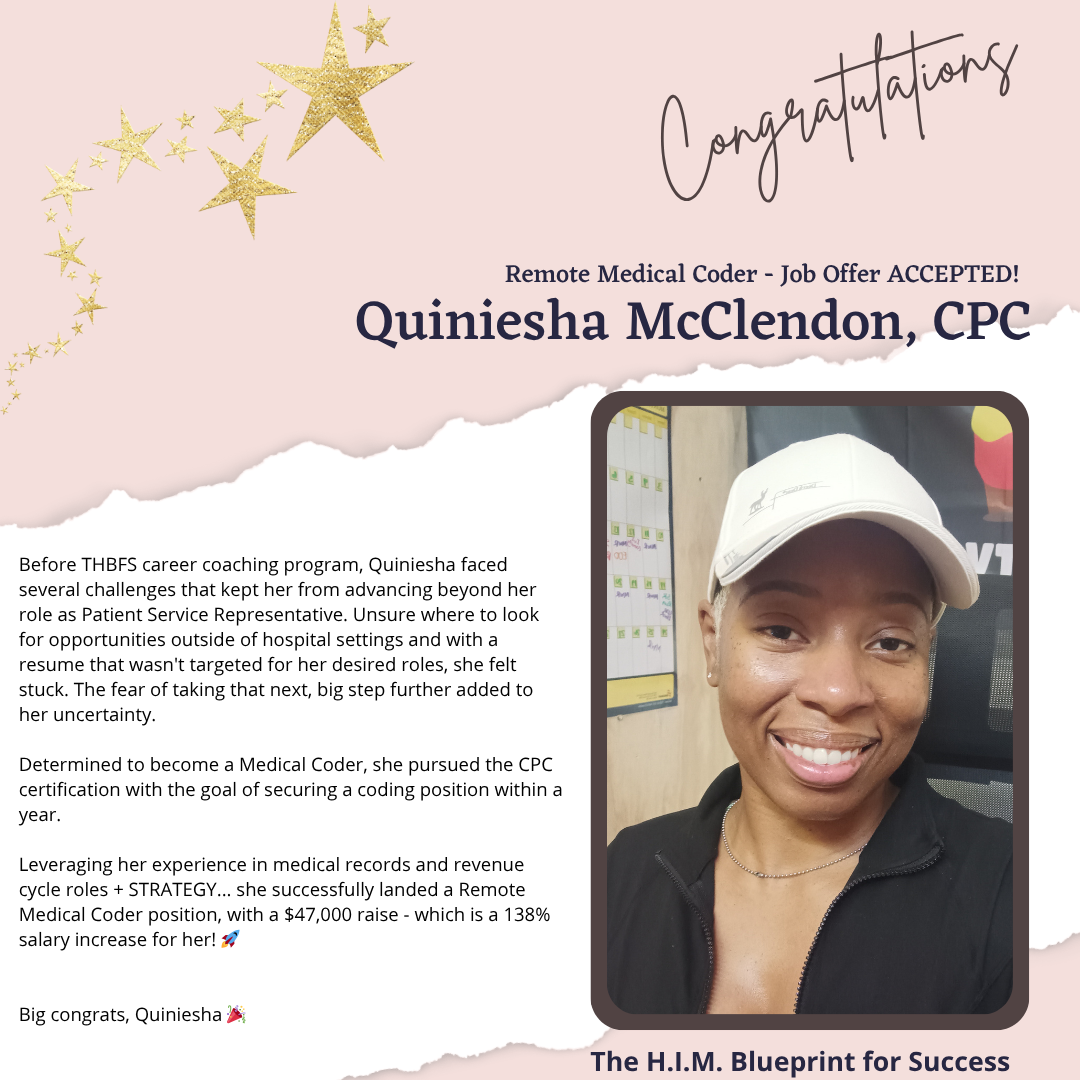
Here is exactly how that happened, and what every front-end revenue cycle professional reading this needs to understand about the path from where you are to where she is now.
Quick Answer: Yes — medical billing and coding is worth it in 2026, especially for front-end revenue cycle professionals who already hold transferable skills from patient registration, medical records, or billing. According to Valerie Page, RHIT, Founder of Blossom Careers, Quiniesha went from Patient Service Representative to Remote Medical Coder with a $47,000 raise — a 138% salary increase — by pairing the CPC certification with a targeted resume strategy and a career search built around her existing expertise. You can score your resume against medical coder job postings right now at blossom-careers.com/resume.
Are Medical Coders in Demand in 2026?
The short answer is yes — and that demand is not shrinking. The Bureau of Labor Statistics projects steady growth in health information and medical records roles through 2032, and medical coding sits squarely inside that growth curve. Healthcare is not getting less complex. Payer requirements are not getting simpler. The need for accurate, compliant coding that protects revenue and keeps claims clean is not going away.
What is changing is where those jobs are. Medical coder remote jobs have expanded significantly post-2020, and employers who once required on-site coders are now actively hiring for fully remote positions — which means the geographic barrier that used to limit your search is gone. Medical coder biller jobs are also on the rise, particularly for candidates who come in with front-end revenue cycle fluency, since those roles sit at the intersection of coding accuracy and billing workflow. The Blossom job board at blossom-careers.com has a dedicated section for medical coder roles, including remote postings and medical coder entry level jobs, updated regularly.
On the salary side, medical coder pay varies by specialty, experience, company size, geographical location of company and certification — but the floor has moved up. Medical coder billing salary for remote positions with a CPC in hand typically starts between $45,000 and $60,000 and scales significantly with auditing or specialty coding experience. Quiniesha's $47,000 raise reflects what happens when a candidate with the right background stops underpricing herself and starts applying to roles that match what she actually knows.
Is There a Future in Medical Billing and Coding?
The concern about AI replacing medical coders comes up every few months, and it deserves a real answer — not a dismissal. AI-assisted coding tools exist, and they are being used. But accurate, compliant coding still requires human expertise to review, validate, and catch what automated tools miss. AAPC and AHIMA are both on record that certified coders remain essential to healthcare organizations — and that professionals who understand the clinical and revenue cycle context behind a code are not replaceable by a tool that simply pattern-matches.
The coders who are going to thrive are the ones who understand the revenue cycle holistically — who know how a claim is built, where it can fail, and why accuracy at the code level matters to the organization's bottom line. That is exactly the background that a Patient Service Representative, a medical records professional, or a front-end revenue cycle specialist already has. That context is not something you can automate. It is exactly what Quiniesha brought to the table — and exactly what made her a competitive hire even as a newer coder.
What the PSR Background Actually Gives You That Other Candidates Don't Have
Here is what gets missed when revenue cycle professionals look at job postings for medical coders and see a list of requirements they don't meet yet. They look at the things they don't have — the CPC, the years of coding-specific experience — and they stop reading. They don't look at what they already bring that a candidate coming straight out of a coding program does not.
A Patient Service Representative who has spent years in front-end revenue cycle already understands:
- How patient information flows through a healthcare system — from registration through documentation, the intake process that coders work downstream from every day
- Insurance verification and payer requirements — the front-end checks that determine whether a claim will be paid before the coding even begins
- Medical records and documentation — the familiarity with chart structure, record types, and clinical documentation that makes reading a chart for coding purposes far less foreign
- Revenue cycle interdependence — the working knowledge of how the front end connects to the back end, how errors upstream create problems downstream, and how coding fits into the full revenue picture
- Patient-facing compliance awareness — HIPAA, patient privacy, and the care with which protected health information is handled, which is non-negotiable in any coding role
None of that shows up automatically on a resume. That is the problem. When Quiniesha's resume was reviewed using the RACA Resume Method at Blossom, the gap between what she knew and what her resume was communicating was the real barrier — not the CPC she was still working toward.
How Long Does It Take to Get the CPC Certification?
This is one of the most common questions from front-end revenue cycle professionals considering the pivot, and the honest answer is: it depends on the time you can commit, but it is more achievable than most people think.
- Self-study with AAPC materials: Most candidates take 3–6 months studying part-time before sitting for the exam
- Structured coding programs: Community college and online programs typically run 6–12 months and prepare you for the CPC exam as part of the curriculum
- The exam itself: The CPC from AAPC is a 100-question exam; passing requires a 70% or higher; most candidates sit within 6–12 months of beginning preparation
- After passing: Two years of professional coding experience are required to remove the apprentice (CPC-A) designation — but many employers hire CPC-A candidates and support the experience requirement on the job
Quiniesha pursued the CPC with a one-year goal in mind. She did not wait until after the exam to start her job search or start building her targeted resume. That is a critical distinction. The job search strategy and the certification pursuit happened in parallel — not in sequence.
Can You Get a Medical Coding Job Without Years of Experience?
Yes — but only if your resume is doing the work of making the case for you. Entry-level medical coding roles exist, and the Blossom job board has a dedicated entry-level section at blossom-careers.com/jobs specifically for candidates who are building toward their first coding position or recently earned their CPC.
What separates the candidates who get those entry-level offers from the ones who apply for six months with no response is almost always the resume. Specifically:
- A professional summary written to bridge the pivot — not a general career overview, but a direct statement of your healthcare background, your revenue cycle expertise, and how it connects to what a coding team needs
- Career highlights that prove clinical and revenue cycle fluency — quantified wins from your current role that show you understand documentation, payer requirements, and healthcare data
- Skills categorized clearly — professional skills (EHR systems, coding software, clinical terminology, revenue cycle workflow) separated from personal skills, easy for a recruiter to scan
- Achieving language throughout — every bullet point showing what improved, what was caught, what was resolved, not just what you were assigned to do
Before Quiniesha's resume was reviewed, it was not telling that story. It was describing a PSR role in PSR language. After the review and rebuild using the RACA method, it was describing a healthcare professional with deep revenue cycle and medical records fluency who had added the CPC — exactly what a coding hiring manager wants to see.
How the Resume Score Exposed What Was Really Blocking Her
One of the most important things Quiniesha did before she started applying was score her resume against the medical coder roles she was targeting. The resume scoring built into the Blossom Careers platform at blossom-careers.com/resume runs an ATS match analysis — it tells you, on a scale of 0 to 100, how closely your resume matches the language of a specific job posting.
Most candidates applying for medical coding roles from a front-end revenue cycle background score low — not because they are unqualified, but because the language of a PSR or patient access role does not naturally overlap with the language of a coding job description. The keywords are different. The framing is different. The evidence an ATS is scanning for is different.
Knowing that score before applying is what changes everything. It stops the guessing. It shows you exactly which keywords are missing — not in general, but against the specific role you want. And it gives you a clear, fixable list of changes to make before you submit a single application.
"Most people apply blind. They send the same resume to every role and wonder why they aren't hearing back. The score tells you the truth — and once you know it, you can fix it." — Valerie Page, RHIT, Founder of Blossom Careers
Quiniesha fixed it. And three months after she started applying with a resume that was actually matched to her target roles, she had an offer on the table — remote, with a $47,000 raise.
What made that possible was not a generic resume tool. It was a scorer built specifically for HIM and Health IT professionals — designed by someone who spent 19 years inside the healthcare system, 7 years hiring in this industry, and 6 years coaching the people who work in it. That context is in every recommendation the tool makes. See exactly how it works:
Click through the demo above — no account required to see how the scorer works.
What Blossom's Elite Tier Actually Did for Her Job Search
The strategy piece matters as much as the resume — and that is what working inside Blossom's Elite tier provided. This is not a course you complete and a certificate you print. It is a career strategy built around your specific Unique Career Advantage, applied to a targeted job search in your specific area of the healthcare field.
For Quiniesha, the strategy included identifying exactly how her PSR and medical records background positioned her as a stronger coding candidate — not a career changer starting from zero, but a healthcare professional adding a certification that formalizes expertise she was already building. That reframe matters. It changes how you write your resume, how you write your cover letter, how you talk about yourself in an interview, and which roles you target in your search.
It also included creating a strategic job search strategy to discover the right roles with the right companies. So her search was aimed at roles that matched her profile, not just any posting with the word "coder" in the title. Which Blossom has a dedicated section for medical coding roles, including entry-level positions and remote opportunities.
Will Medical Coding Be Phased Out by AI?
This is the fear underneath a lot of the "is it worth it" questions, so it deserves a direct answer. AI-assisted coding is real. It is being adopted. And it is changing some of the more routine, repetitive aspects of high-volume coding. But here is what is also true: the healthcare organizations adopting those tools still need credentialed, experienced coders to audit, validate, and catch what the tools miss — which they do, consistently, in complex clinical scenarios.
What AI does not replace is the human who understands why a claim was coded the way it was, what the documentation actually says, and where the compliance risk lives. That judgment comes from real clinical and revenue cycle experience. Quiniesha has it. She always had it. The CPC gave her the credential to go with it — and together, those two things made her the kind of coder employers are actively looking for in 2026, not in spite of AI adoption but precisely because of it.
The coders who will struggle are the ones who never developed the clinical and revenue cycle context to go deeper than the code itself. The ones who come in with that context — from patient registration, medical records, revenue cycle — are positioned to be the validators, the auditors, the senior coders. That is the path Quiniesha is on.
Is Medical Coding Worth It in 2026? Here Is the Real Answer.
For a front-end revenue cycle professional with medical records, billing, or patient access experience, the question is not really whether medical coding is worth it. The question is whether you are going to make the move strategically or keep applying the same way and getting the same result.
The CPC certification is worth pursuing. The pivot is achievable. And the salary difference — Quiniesha's 138% raise is not an outlier, it is what happens when someone with the right background finally has a resume and a job search strategy that match what they actually know.
If you are ready to find out where your resume stands against the coding roles you want, score it at blossom-careers.com. If you want to see what medical coding roles are actively posting — including entry-level and remote — the Blossom job board is where to start. And if you want to do what Quiniesha did — build the strategy, rebuild the resume, and stop applying blind — that work happens inside Blossom Careers.
The career map at blossom-careers.com/career-map.html shows you exactly where medical coding fits into the broader HIM and health IT career ladder — including what roles come after the CPC and what the salary ceiling looks like when you keep building. Go to the most recent post and drop a comment if you want a full breakdown of which coding specialties pay the most in 2026 and what it takes to get there.
Score your resume against medical coding roles before you apply. Know your number. Fix the gaps. Apply with confidence.
Score My Resume →