Home Career Map Medical Coder Career Pivots

Career Pivot Guide

What jobs can a medical coder transition into?

You've invested in your credential, your coding knowledge, and your clinical vocabulary. You don't have to start over. This guide covers 40+ pivot paths built specifically around what coders already know — ICD-10-CM/PCS, CPT, payer policy, and clinical documentation.

40+
pivot roles covered
9
career pivot paths
$48K–$145K+
salary range across pivots
Free resource: Get the HIM & HIT Career Map — 300+ roles, 14 specialties, two career tracks.
No credit card. No paid plan. Your resume guide delivers instantly when you join.
🌸 Join the Talent Community — free

The honest reason

Why medical coders look for career changes

Medical coding is a genuine skill. You learned anatomy, physiology, pathophysiology, and pharmacology. You navigated ICD-10-CM/PCS and CPT. You built pattern recognition that most people in healthcare simply don't have. That knowledge is enormously valuable — but the job itself, for a lot of coders, eventually stops being fulfilling.

Productivity quotas. Remote isolation. The same denial reason codes on repeat. A ceiling on pay that doesn't reflect how much you actually know. If you're feeling that, you're not alone — and more importantly, the skills you built didn't plateau just because the job did.

🌸 From Valerie, RHIT

In 19+ years in HIM and revenue cycle, the most common question I've gotten from coders isn't "how do I code this?" — it's "what else can I do with this?" The answer is: a lot. Your coding knowledge is a foundation, not a ceiling. The pivot isn't about leaving what you know. It's about deploying it somewhere that pays more, challenges you more, and lets you grow.

The good news: the ICD-10-CM, CPT, and HCPCS knowledge you have is domain expertise that takes years to build. Every pivot path in this guide exists because of that knowledge, not in spite of it.

Your hidden résumé

Transferable skills medical coders already have

Most career transition guides list generic skills like "attention to detail." That's not what this is. These are the specific competencies you developed doing coding work — the ones that make you uniquely valuable in roles that pay significantly more.

📋
ICD-10-CM/PCS Guidelines
Annual CMS/NCHS guidelines — the legal rulebook for diagnosis coding. Used in CDI, compliance, auditing, and payer policy.
💉
CPT & HCPCS Level II
Procedure and supply codes used in billing, revenue integrity, and payer contract analysis.
🏥
Clinical Documentation
You know what a physician note needs to say to support a code. That's the core competency of CDI.
⚠️
Denial Reason Codes
CARC, RARC, and claim adjustment codes — the vocabulary of revenue cycle analysts.
🔍
Payer Policy
LCD and NCD awareness, prior auth patterns, payer-specific rules. Direct overlap with compliance roles.
📊
DRG Logic
How diagnoses and procedures drive DRG assignment and reimbursement. Core to revenue integrity and CDI.
🔒
HIPAA Minimum Necessary
The regulatory framework you apply every time you pull or release a medical record.
🗂️
Anatomy & Pathophysiology
The clinical vocabulary that makes you credible to physicians, CDI colleagues, and clinical compliance teams.

Word cloud of skills

Every term below is drawn directly from the ICD-10-CM Official Guidelines for Coding and Reporting
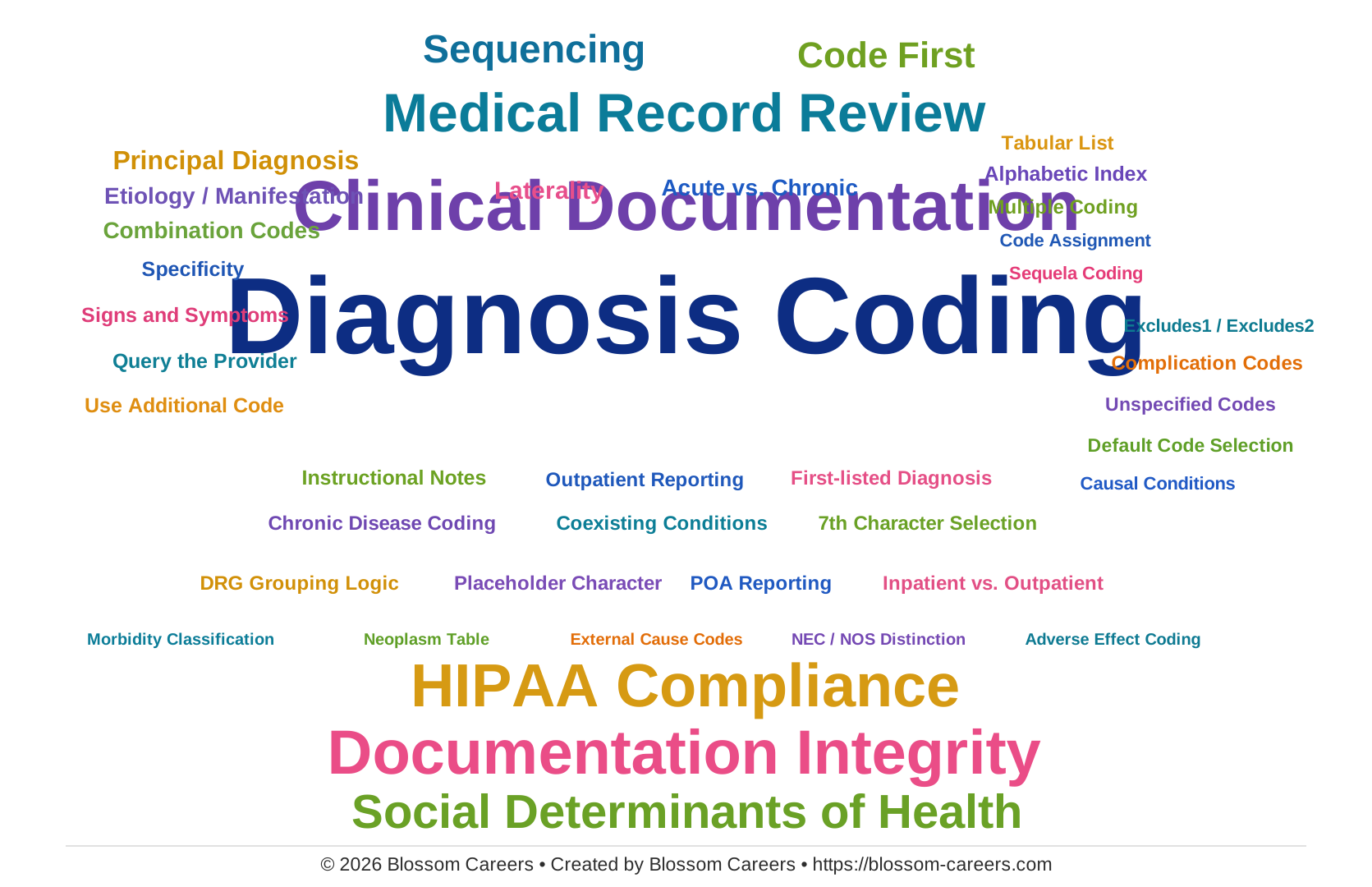
Word cloud of medical coder transferable skills sourced from ICD-10-CM Official Guidelines FY2026, by Blossom Careers

🌸 Industry perspective

Other career sites talk about "transferable skills" generically. But here's what they miss: a coder who has worked denials knows the exact reason code CO-4 (Inconsistent modifier) means something different at Medicare vs. a commercial payer. A CDI consultant who knows that distinction is worth far more than one who doesn't. Your knowledge isn't generic. Market it specifically.

The options

9 career pivot paths for medical coders

Each path below shows the connection between what you already know and what the new role requires, the specific job titles you can target, and the credential that validates your move. Click any card to expand.

📝
Clinical Documentation Improvement (CDI)
Reviewer of the records you used to code
Strong pivot High demand $60–$95K

CDI specialists work alongside physicians and coders to ensure that clinical documentation accurately reflects the patient's severity of illness — before and after coding. If you've ever thought 'this note doesn't support the code,' that's CDI thinking.

What you already bring

ICD-10-CM/PCS coding knowledgeDRG validation logicClinical documentation standardsCC/MCC impact on reimbursementPhysician query experienceMDC and MS-DRG grouping

Job titles to target

  • Clinical Documentation Specialist
  • CDI Improvement Specialist
  • Ambulatory CDI Specialist
  • CDI Reconciliation Auditor
  • Outpatient CDI Specialist
  • CDI Educator

🌸 Industry insight

Coders are the most natural pipeline into CDI. The CDIP (AHIMA) or CCDS (ACDIS) credential validates the transition formally. Outpatient CDI is a growing area.

Credential to pursue: CDIP — AHIMACCDS — ACDIS
🔍
Coding Quality & Compliance Audit
Reviewing the work — and protecting the organization
Strong pivot High demand $65–$110K

Coding auditors review coded records for accuracy, compliance, and risk — pre-payment or post-payment. This is one of the highest-value uses of a coder's knowledge because the risk of miscoding has direct financial and legal consequences.

What you already bring

ICD-10-CM/PCS and CPT expertiseOIG Compliance guidancePayer policy awareness (LCD/NCD)Documentation-to-code linkageAudit methodologiesDenial pattern recognition

Job titles to target

  • Coding Auditor
  • DRG Validation Coding Auditor
  • Professional Coding Auditor & Educator
  • HB Coding Integrity Specialist
  • Coding Compliance Audit Specialist
  • Physician Billing Coding Auditor

🌸 Industry insight

The OIG Work Plan publishes annual focus areas for coding audit risk. Coders who can map it to ICD-10-CM guideline violations are exceptionally valuable. CPMA (AAPC) is the gold-standard credential.

Credential to pursue: CPMA — AAPCCCS — AHIMA
💰
Revenue Integrity & Charge Description Master (CDM)
Where coding meets charge capture
Strong pivot Growing $58–$105K

Revenue integrity professionals sit at the intersection of clinical services, coding, and billing. They ensure that the charge captured in the CDM is supported by the code — and that both are supported by the documentation.

What you already bring

CPT and HCPCS code structureRevenue code familiarityDiagnosis and procedure linkagePayer billing requirementsCharge-to-code relationshipOIG compliance awareness

Job titles to target

  • Revenue Integrity Analyst
  • Revenue Integrity Specialist — Clinical
  • Charge Description Master Analyst
  • CDM Process Analyst
  • DRG Auditor
  • Reimbursement Specialist

🌸 Industry insight

The CHRI (NAHRI) credential is purpose-built for this path. Revenue integrity consistently pays above mid-level coding and has strong remote availability.

Credential to pursue: CHRI — NAHRICRIS — NAHRI
⚖️
Healthcare Compliance
Keeping organizations on the right side of the rules
Strong pivot Growing $55–$100K

Compliance professionals ensure organizations follow healthcare laws, billing regulations, and payer contracts. Medical coders who understand HIPAA, the False Claims Act, and CMS billing rules are ideal candidates.

What you already bring

HIPAA regulationsCMS billing and coverage guidelinesOIG fraud and abuse frameworkAudit trail documentationFalse Claims Act risk awarenessPayer-specific billing policies

Job titles to target

  • Compliance Specialist — Privacy
  • 340B Audit & Compliance Analyst
  • Coding Compliance Audit & Education Specialist
  • HIM Coding Quality Officer
  • Director of Medicare & Regulatory Compliance
  • SIU Investigator

🌸 Industry insight

Coding-background compliance professionals can trace a finding back to the specific ICD-10-CM code, guideline violated, and documentation gap. That specificity is rare and extremely valuable.

Credential to pursue: CHC — HCCACPCO — AAPC
📈
Revenue Cycle Analysis & AR
Data, denials, and the business of healthcare billing
Strong pivot High demand $52–$88K

Revenue cycle analysts identify patterns in claims, denials, and AR data to find root causes and process improvements. Coders understand why a claim denied — not just the denial code, but the clinical and coding reason behind it.

What you already bring

Denial reason code interpretation (CARC/RARC)Claim lifecycle knowledgeICD-10 and CPT coding accuracyPayer edit logicRoot cause analysisDocumentation-to-billing linkage

Job titles to target

  • Revenue Cycle Specialist
  • Revenue Cycle Systems Analyst
  • Denial Management Analyst
  • AR Recovery Analyst
  • Inpatient Coding Resolution Specialist
  • Revenue Cycle Report Writer

🌸 Industry insight

The biggest gap in revenue cycle analytics is clinical interpretation. A denial analyst who can identify the ICD-10 guideline that was misapplied is not a commodity. That's you.

Credential to pursue: CRCR — HFMARHIT or RHIA — AHIMA
🗂️
Health Information Management (HIM)
Managing the integrity of the medical record
Strong pivot Steady $48–$85K

HIM professionals manage the accuracy, accessibility, and integrity of health information across the enterprise. Coders are the most natural pipeline into HIM because they already understand the clinical record, data governance, and the regulatory environment.

What you already bring

Medical record structureHIPAA Privacy Rule requirementsICD-10 and code set knowledgeROI documentation awarenessEHR and data integrityClinical terminology and abstracting

Job titles to target

  • Health Information Specialist
  • HIM Data Integrity Analyst
  • Release of Information Specialist
  • Medical Records Processing Specialist
  • HIM Supervisor
  • Director of HIM (with RHIA)

🌸 Industry insight

If you're already a CCS or CCS-P, you've demonstrated a significant portion of the competency required for RHIT-level work. AHIMA periodically reviews equivalent credential recognition.

Credential to pursue: RHIT — AHIMARHIA — AHIMA
💻
Epic / EHR Analyst
Configuring the systems coders live inside
Moderate pivot High demand $70–$130K

EHR analysts configure, maintain, and optimize the electronic health record systems that coders use every day. Former coders bring something most IT professionals lack: they understand how coding workflows actually function inside the system.

What you already bring

End-user perspective of Epic HIM modulesHIM workflow within EHRCode set and encoder integrationCharge capture build logicClinical terminology for configurationROI and release workflow experience

Job titles to target

  • Epic Analyst — HIM
  • Epic HIM Analyst
  • Epic Analyst | HIM & Identity
  • Application Lead — HIM
  • Revenue Cycle Epic Informatics Analyst
  • EHR Applications Analyst

🌸 Industry insight

Epic module certification takes 2–6 weeks and is often employer-sponsored. Coders who earn HIM or Professional Billing module certification can transition into analyst roles without a CS background.

Credential to pursue: Epic HIM Cert — EpicCPHIMS — HIMSS
🎓
Coding Education & Quality Review
Teaching what you know
Strong pivot Growing $58–$100K

Coding educators and quality reviewers develop training programs, conduct coder feedback sessions, and identify patterns across coded populations. If you've ever explained a coding concept to a colleague, you've done the core of this job.

What you already bring

Specialty-specific coding expertiseCommon coding error patternsAbility to explain guidelines plainlyPre/post-audit comparison skillsDocumentation-to-code teachingAnnual ICD-10-CM guideline updates

Job titles to target

  • Coding Quality Reviewer and Educator
  • Hospital Coding Educator — Inpatient
  • Coding Compliance Audit & Education Specialist
  • Professional Coding Auditor and Educator
  • Quality Assurance Education Specialist
  • Coordinator — Professional Coding Quality

🌸 Industry insight

Annual ICD-10-CM updates (every October 1) require re-education across coding teams. Coders who specialize in ED coding, oncology, or orthopedics are in demand as specialty-focused educators.

Credential to pursue: CPMA — AAPCRHIA — AHIMA
🖥️
Healthcare Data & Health IT
Turning clinical data into insight
Lateral pivot Very high demand $65–$130K+

Health IT and data roles use clinical data — including coded data — to power reporting, analytics, and population health programs. Coders who develop skills in SQL or BI tools can transition into data analyst roles with a domain expertise advantage.

What you already bring

ICD-10, CPT, and DRG as data fieldsClaim data structure knowledgeClinical context for data anomaliesHIPAA data governance awarenessEHR data extraction familiarityHealthcare regulatory vocabulary

Job titles to target

  • Healthcare Data Analyst
  • HEDIS Reporting Analyst
  • Revenue Cycle Systems Analyst
  • Clinical Informatics Analyst
  • ACO Performance Analytics Analyst
  • Data Quality Lead — Data Governance

🌸 Industry insight

This is a lateral pivot — it requires more new skill development. But coders who add SQL or Tableau to their résumé are among the most in-demand candidates in Health IT. Start with CPHIMS as a transitional credential.

Credential to pursue: CPHIMS — HIMSSCHDA — AHIMA

Side by side

How pivot roles compare to traditional coding

This table compares nine pivot paths against a mid-level production coding role across the dimensions that matter most to coders considering a change.

Role Salary Range Quotas Remote Demand Credential
Medical Coder (mid-level) $48–$68K Yes — daily High Stable / AI pressure CPC or CCS
CDI Specialist $60–$95K Low High Growing CDIP / CCDS
Coding Auditor $65–$110K No High Growing CPMA
Revenue Integrity Analyst $58–$105K No Moderate Growing CHRI / CRIS
Compliance Specialist $55–$100K No Moderate Growing CHC / CPCO
Revenue Cycle Analyst $52–$88K No High High demand CRCR / RHIT
HIM Specialist $48–$85K Low Moderate Steady RHIT / RHIA
Epic HIM Analyst $70–$130K No High Very high Epic HIM cert
Coding Educator $58–$100K No Moderate Growing CPMA / RHIA
Healthcare Data Analyst $65–$130K+ No High Very high CHDA / CPHIMS

📌 A note on salary ranges

Ranges are national estimates based on publicly available data and may vary by employer, geography, and experience. CDI and revenue integrity roles at large health systems frequently exceed listed ranges at the senior level.

Your next credential

Credentials that validate the pivot

You don't have to earn a new credential before you pivot. But the right credential can shorten your job search, increase your starting salary, and signal to employers that your transition is intentional — not accidental.

Pivot credentials at a glance

CDIP
AHIMA
Clinical Documentation Improvement Practitioner. Gold standard for CDI.
For: CDI path
CPMA
AAPC
Certified Professional Medical Auditor. Opens audit and compliance roles.
For: Audit, compliance, education
CHRI
NAHRI
Certification in Healthcare Revenue Integrity. Validates CDM expertise.
For: Revenue integrity path
CHC
HCCA
Certified in Healthcare Compliance. Recognized for compliance roles.
For: Compliance path
CRCR
HFMA
Certified Revenue Cycle Representative. Accessible entry credential.
For: Revenue cycle path
CPHIMS
HIMSS
Certified Professional in Health Informatics. Bridges clinical and IT.
For: Health IT, Epic paths
CHDA
AHIMA
Certified Health Data Analyst. Validates data analytics expertise.
For: Data analyst path
RHIT/RHIA
AHIMA
Core HIM credentials. Requires CAHIIM-accredited program.
For: HIM management path

Common questions

Frequently asked questions

Medical coders can transition into CDI Specialist, Coding Auditor, Revenue Integrity Analyst, and Compliance Specialist — all of which pay more than production coding and have lower productivity pressure. Roles in Epic/EHR analysis and healthcare data are also increasingly accessible. This page covers 40+ specific job titles across 9 career paths.
It depends on what's driving the desire to move. For more clinical engagement, the next step is CDI. For independence and higher pay, coding audit (CPMA) is the clearest path. For the business side, revenue integrity or revenue cycle analysis. For technology, an Epic HIM analyst role leverages your EHR familiarity. None of these require starting over.
AI and CAC tools are automating high-volume routine claim lines — primarily straightforward outpatient coding. However, roles that require clinical judgment — CDI querying, coding audit, denial management, compliance — are not automatable. CMS updates the ICD-10-CM Official Guidelines every October 1, and those changes require human expertise to interpret, teach, and apply.
In most cases, no. The nine pivot paths on this page are accessible through professional credentials (CDIP, CPMA, CHRI, CHC, CRCR) rather than new degrees. The exception is HIM management roles (Director or above), which typically require the RHIA from a CAHIIM-accredited program. Epic analyst roles require only module certification, which takes weeks and is often employer-sponsored.
Yes — most pivot paths on this page have strong remote availability. CDI, coding audit, revenue integrity, revenue cycle analysis, Epic analyst, and healthcare data analyst roles are all commonly posted as remote or hybrid.
With only a CPC, the most accessible pivots are: entry-level CDI Coordinator, Coding Quality Reviewer, Revenue Cycle Specialist, and Compliance Specialist. Adding the CPMA opens coding auditor roles. Revenue integrity analyst roles often hire credentialed coders with a CHRI added within the first 12 months on the job.

Free Tool

Is your resume actually getting seen?

Paste your resume + a job description. Get your ATS score in 60 seconds — free, no credit card required. HIM-specific scoring built for coders, billers, and revenue cycle professionals.

🚀 Scan My Resume Free

Then create a free account to see your full score + what to fix.

Keep exploring

More free resources on Blossom Careers

The full HIM & HIT Career Map covers 300+ roles across 14 specialties with two career tracks, salary ranges, and credential guidance — completely free.

See open jobs in these pivot roles

Blossom's job board is built specifically for HIM, coding, and revenue cycle professionals — not a generic job site.

Browse HIM Jobs →